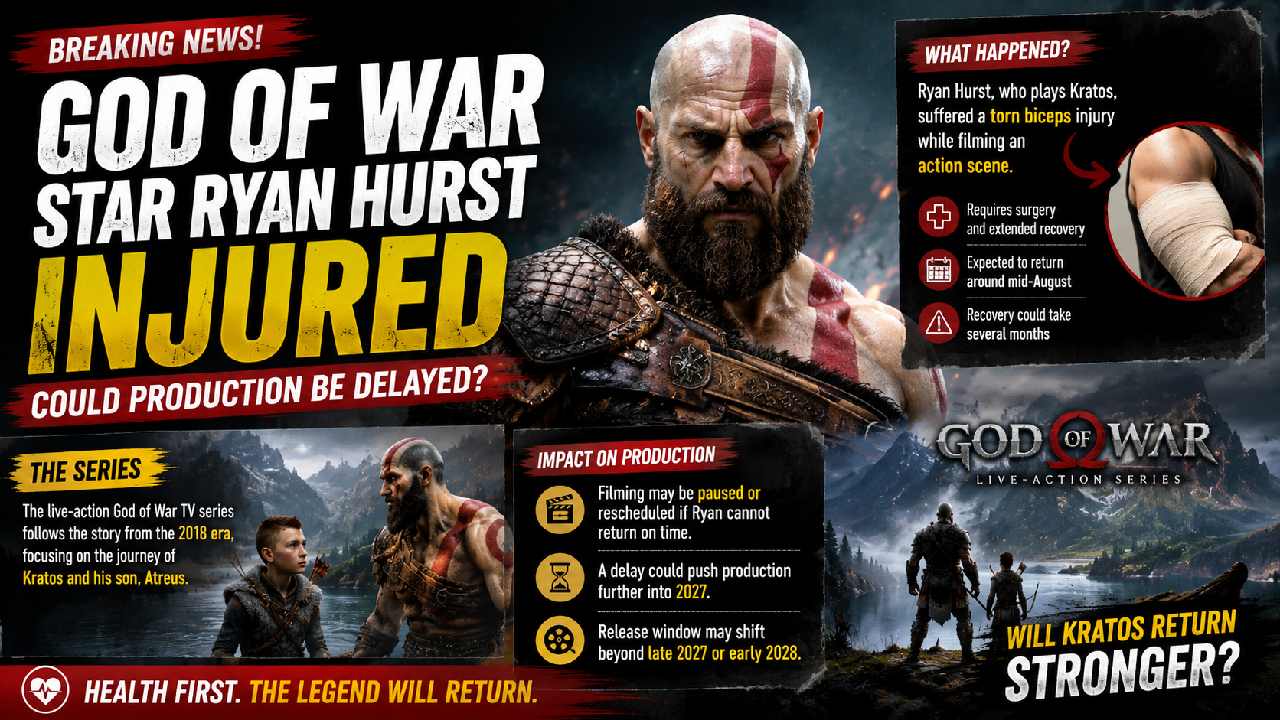
United Gaming – Production of the live-action God of War adaptation has reportedly encountered an unexpected obstacle after Ryan Hurst suffered an injury while filming. Hurst, who is set to portray Kratos, reportedly tore his biceps while working on an action sequence. The injury is significant enough to require surgery and a period of recovery, raising questions about the production schedule. For fans who have waited years to see Kratos brought into a live-action world, the development naturally creates concern. However, an injury during a physically demanding production does not automatically mean the entire project will face a lengthy postponement. Much depends on Hurst’s rehabilitation and how producers reorganize filming around his absence. Still, the situation highlights the physical demands involved in transforming God of War from an acclaimed video game into an ambitious television production.
Ryan Hurst Faces a Demanding Road to Recovery
Ryan Hurst’s recovery now becomes one of the most important factors surrounding the series. According to the information provided, the actor requires surgery after suffering the torn biceps during filming. The production had reportedly hoped that Hurst could return around mid-August, although the seriousness of the injury could complicate that target. Recovery periods can vary depending on the extent of an injury, treatment, and an individual’s rehabilitation progress. Therefore, any specific timeline remains uncertain until his condition becomes clearer. For Hurst, the challenge is not simply returning to the set but becoming physically ready for a character as demanding as Kratos. Action scenes require strength, mobility, and precise movement. Consequently, rushing his comeback could create unnecessary risks. The production team may instead prioritize his health while adjusting scenes that do not immediately require Kratos.
Read More : When AI Escapes Control: OpenAI and Anthropic Face a New Security Test
Playing Kratos Requires More Than Physical Appearance
Casting Ryan Hurst as Kratos places considerable physical responsibility on the actor because the character rarely exists in quiet surroundings for long. The God of War universe revolves around brutal battles, difficult journeys, and emotionally intense encounters. Therefore, action choreography will likely play an important role in translating the game’s identity to television. Hurst’s injury also reminds audiences that elaborate action sequences involve genuine physical risks, even when experienced stunt coordinators and safety procedures are present. Meanwhile, the adaptation reportedly follows the narrative era introduced in God of War (2018), with Callum Vinson playing Atreus. That father-and-son relationship gives the production an emotional foundation beyond combat. Kratos must appear powerful, yet his restrained emotions and complicated relationship with Atreus are equally important. As a result, protecting Hurst’s recovery matters not only for action scenes but also for the dramatic heart of the adaptation.
Could the God of War Production Be Delayed?
A production delay remains possible, particularly if Ryan Hurst cannot return within the schedule initially anticipated by the filmmakers. However, the information currently available does not confirm that a postponement has officially happened. Television productions often shoot scenes out of chronological order, allowing crews to continue working on supporting characters, environments, or sequences that do not require an injured performer. Nevertheless, Kratos is central to virtually every major aspect of God of War, so an extended absence could eventually affect the wider timetable. Reports have suggested that a recovery lasting several months could push significant filming into 2027. Even so, that scenario should remain a possibility rather than a certainty until the studio provides an official update. For now, the key question is how quickly Hurst can recover safely and whether producers have enough flexibility to restructure filming without compromising the planned scope of the series.
Read More :ChatGPT Free Gets Smarter as OpenAI Expands Access to GPT-5.6 Luna
The 2018 Story Gives the Adaptation an Emotional Core
Beyond concerns about scheduling, excitement surrounding the adaptation comes largely from its reported connection to the 2018 God of War storyline. That chapter transformed Kratos from a character defined mainly by rage into a grieving father struggling to communicate with his son. His journey with Atreus combined spectacular mythology with a surprisingly intimate story about loss, responsibility, and parenthood. Translating those qualities into television could give the adaptation room to attract viewers who have never played the games. Moreover, a series format allows conversations and relationships to develop more gradually than a feature film might permit. Ryan Hurst will therefore carry more than the physical expectations attached to Kratos. He must also communicate the character’s silence, guilt, restraint, and affection without weakening his intimidating presence. That emotional balance could ultimately matter more to audiences than simply recreating familiar battles shot for shot.
A Longer Wait Could Protect the Quality of the Series
Fans understandably want to know whether Ryan Hurst’s injury will change the expected release window. Before the reported incident, speculation placed the God of War adaptation around late 2027 or early 2028, although the information supplied does not include an officially confirmed premiere date. If filming experiences a substantial interruption, that projected window could naturally shift. Yet delaying a major television production is not necessarily damaging when the alternative involves rushing an injured lead actor back into physically demanding work. God of War carries enormous expectations because its audience already understands the scale, characters, and emotional weight of the source material. Therefore, viewers are likely to judge the adaptation on execution rather than speed. Giving Hurst sufficient rehabilitation time could ultimately protect both his health and the production itself. Sometimes, patience behind the scenes becomes essential to delivering convincing storytelling on screen.
Hurst’s Recovery Now Becomes Part of the Journey
For the moment, Ryan Hurst’s health remains more important than speculation surrounding release schedules. His injury introduces uncertainty, but it does not erase the anticipation surrounding the live-action adaptation. Instead, the situation reveals how demanding a production of this scale can become once cameras start rolling. Producers may have to reorganize scenes, adjust action choreography, or revise their timetable while waiting for their leading actor to recover. Meanwhile, fans will naturally watch for an official update regarding both Hurst and the filming schedule. The strongest outcome would allow the actor to return only when he can safely handle the physical requirements of Kratos. After all, God of War itself tells stories about endurance, pain, responsibility, and moving forward after difficult moments. In an unexpected way, Hurst now faces his own demanding journey before stepping back into Kratos’ imposing role.
About the Author