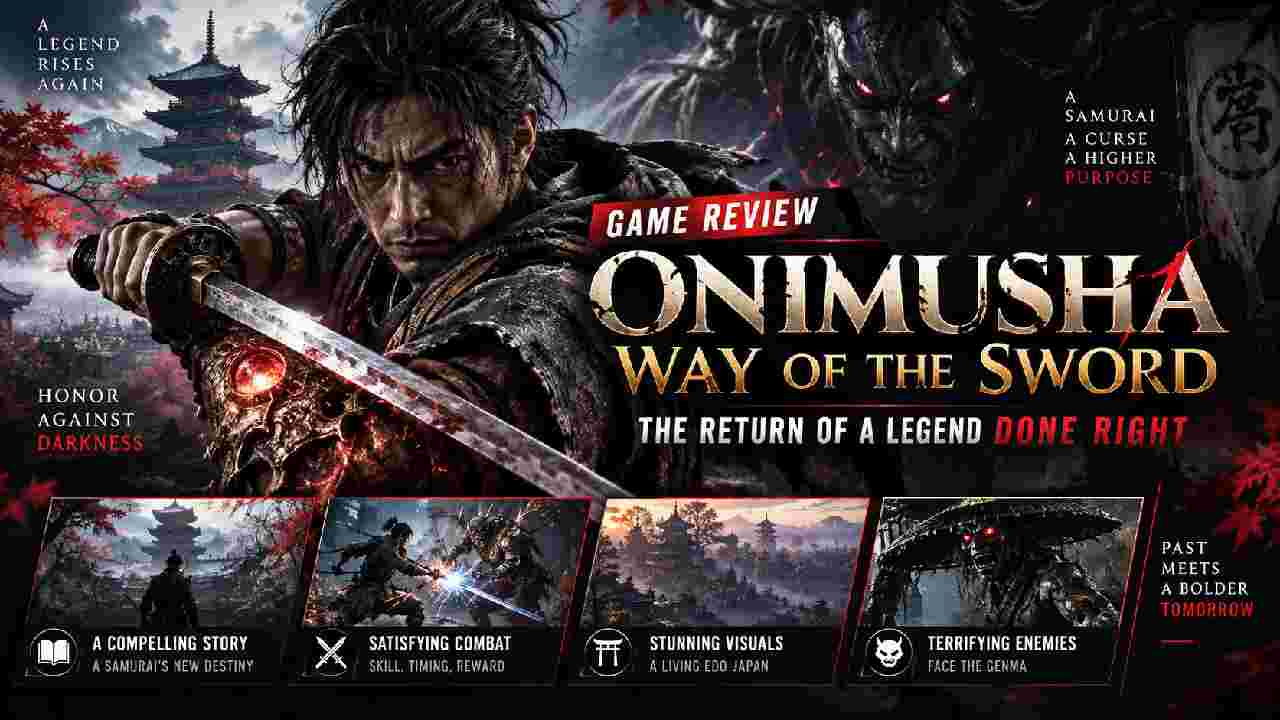
United Gaming – Onimusha Way of Sword brings Capcom’s long-running action series back with a dark journey through Edo-era Kyoto. At the center stands Miyamoto Musashi, a samurai driven by one simple dream: becoming the strongest warrior. His path changes violently after a battle with the terrifying Genma ends in his death. Instead of disappearing forever, Musashi encounters a mysterious man in the afterlife who forces an Oni Gauntlet onto his right arm. He returns to the human world with new power and an unexpected duty. From that moment, his personal search for strength becomes a fight to protect humanity and stop Genma from escaping through the gates of hell. The setup feels easy to follow, yet it gives the adventure emotional weight. More importantly, it quickly establishes Musashi as a fighter caught between personal ambition and a responsibility he never asked to carry.
Samurai Cinema Gives the Story a Distinctive Soul
The story works because Capcom treats its simple premise with a strong cinematic identity. Rather than filling every scene with complicated explanations, the game builds atmosphere through characters, locations, and dramatic encounters inspired by Japanese samurai films. Historical figures appear in fictional forms, while the dark fantasy setting gives familiar names a supernatural edge. Musashi therefore feels connected to Japanese history without becoming trapped by strict realism. During cutscenes, facial expressions, measured conversations, and carefully staged confrontations often make the experience resemble a samurai television drama. This approach gives quieter scenes enough personality to stand beside the violent battles. It also helps new players because the story can stand on its own without demanding deep knowledge of earlier Onimusha titles. As each mission reveals more about the Genma threat, curiosity becomes a natural reason to keep moving forward and discover what waits beyond Kyoto.
Read More : Modified RTX 5090 Hits 900W Using Three 8-Pin Connectors
Precision Combat Turns Every Duel Into a Thrill
Combat is the strongest reason to keep playing Onimusha: Way of the Sword. Musashi can attack with his katana and weapons connected to the Oni Gauntlet, but enemies rarely wait quietly for their turn. Each opponent brings attack patterns that encourage players to watch movement and react at the right moment. Dodge, block, parry, and Issen form the heart of this system. Reflex Dodge helps against melee attacks or grabs, while a well-timed parry creates an opening for a counterattack. Issen offers the greatest thrill because it can deal enormous damage and may defeat an enemy quickly. However, its timing window is strict, so every attempt carries real risk. This balance makes successful counters feel earned rather than automatic. Once players understand enemy rhythms, battles become less about frantic button pressing and more about patience, observation, and the satisfying moment when one precise response turns danger into victory.
Progression and Exploration Keep Musashi Moving Forward
Progression gives the combat system room to grow without burying players under unnecessary complexity. Musashi can unlock and improve abilities, clothing, katana options, and features tied to the Oni Gauntlet by collecting special items and Red Souls. Exploration follows a stage-like or dungeon-based structure, with missions that send players into areas filled with Genma and other dangers. Objectives include destroying monster nests, clearing corrupted energy, rescuing local residents, collecting useful items, and closing rifts. These activities keep the player moving, although combat remains the main attraction throughout the adventure. Kyoto also serves as an important space for exploration and side content. However, repeated tasks can eventually feel familiar, especially when missions rely on similar objectives. Fortunately, the map is not excessively large, and teleport points reduce unnecessary travel. As a result, slower exploration rarely overwhelms the faster, more exciting rhythm found in major story missions.
Read More :Intel CPU Prices Could Rise 10% as the Chipmaker Prepares for Its Next Big Launch
RE Engine and Japanese Sound Create a Rich Atmosphere
Visually, Onimusha: Way of the Sword makes strong use of Capcom’s RE Engine. Environments, character models, animation, and cinematic presentation all support the dark fantasy atmosphere, while the Genma look deliberately grotesque and threatening. Their disturbing designs make combat feel more physical because every encounter places Musashi against creatures that seem genuinely unpleasant to face. Cutscenes provide another showcase, especially through facial movement and character expressions that strengthen dramatic moments. The PC experience described in the source also performed well without major problems that seriously disrupted play. Even lower graphical settings can still provide a solid experience, although stronger hardware naturally allows the visual detail to stand out more clearly. Sound adds another layer of personality. Traditional Japanese instruments accompany both story scenes and gameplay, while the sharp sounds of katana swings, clashes, and strikes give battles extra force. Together, the audiovisual elements make each confrontation feel more immediate.
Uneven Pacing Cannot Hide the Strong Main Adventure
Despite its strengths, the adventure does not maintain the same pace at every moment. The opening introduces several tutorials, and some lessons continue even after players may feel they already understand the basic flow. After an early boss encounter, the game still introduces more guidance around city exploration, corrupted areas, and other systems. That stop-and-start structure can interrupt the momentum of a title whose greatest strength is combat. Side activities in Kyoto may also become repetitive because several objectives return in similar forms, such as defeating Genma or collecting items from marked locations. These weaknesses matter, but they do not erase the appeal of the main journey. Story missions often lead to different locations, tougher enemies, stronger bosses, and more engaging narrative developments. Whenever the game shifts its attention back toward Musashi’s central mission, the pace improves noticeably and the qualities of the combat system become easier to appreciate again.
A Welcoming Revival for Veterans and New Players
Onimusha: Way of the Sword feels welcoming even for players who never followed the older games. Its story works independently, while the combat provides enough depth for players who enjoy learning timing without demanding perfect reactions at every moment. On the Action difficulty described in the source review, enemy attacks remain readable, and groups often approach with a rhythm that gives players time to respond. Bosses also show brief pauses before launching some patterns, creating a duel-like feeling that recalls classic samurai cinema. That design choice makes the action challenging without turning every encounter into constant pressure. More importantly, the game combines its mechanics with a clear sense of identity. Musashi’s journey, the Genma threat, Japanese-inspired music, and cinematic presentation support one another. The uneven tutorials and repetitive side activities remain noticeable, yet the main missions deliver enough excitement to make this revival feel confident and worthwhile.
About the Author