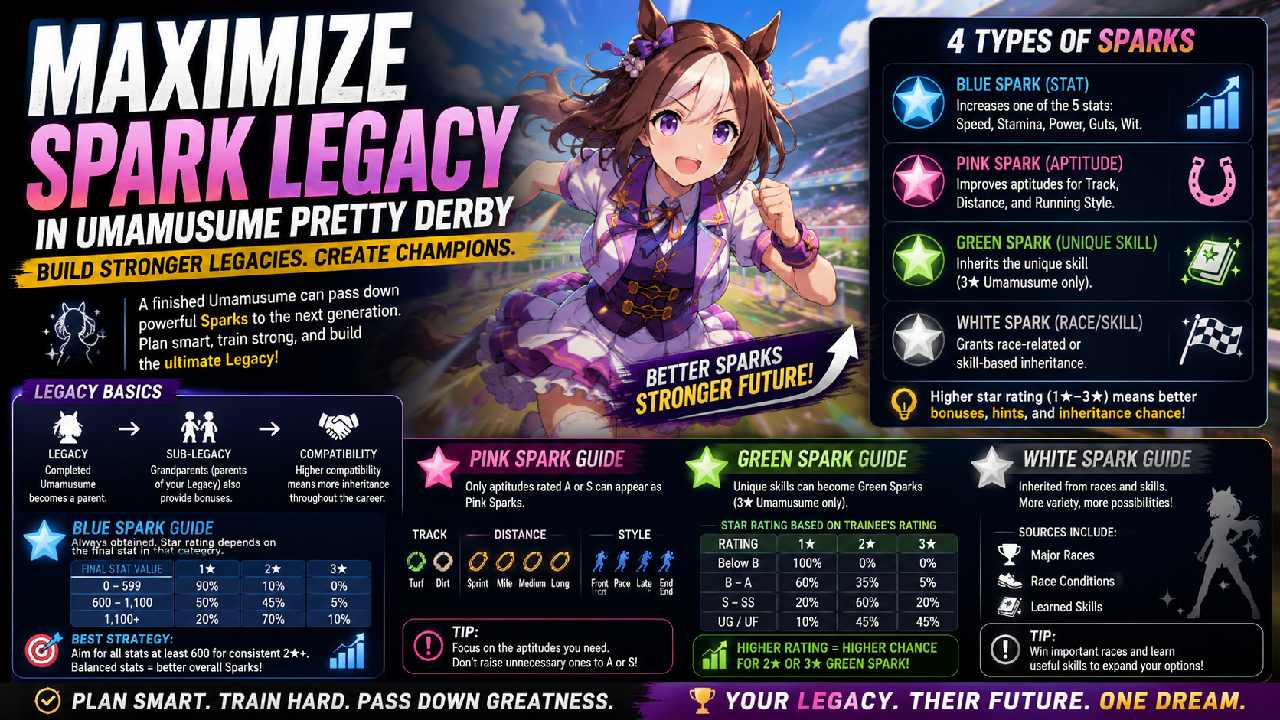
United Gaming – Building a strong trainee in Umamusume Pretty Derby does not end when one career run finishes. In many ways, that finish line becomes the starting point for the next generation. A completed Umamusume can become a Legacy and pass valuable bonuses to another trainee through Sparks. This inheritance system creates a rewarding cycle where careful preparation today can make future runs stronger. However, getting useful Sparks requires more than simply completing careers repeatedly. Players need to understand compatibility, stats, aptitudes, unique skills, and the role of Sub-Legacies. The Umamusume Spark Legacy Guide becomes especially useful when players begin chasing specific builds instead of relying entirely on luck. By planning each parent carefully, trainers can improve their chances of receiving stronger inheritance bonuses. The process still involves randomness, but smart preparation can turn that uncertainty into a much more manageable part of long-term progression.
Understanding Legacy and Sub-Legacy Before Farming Sparks
Legacy allows players to use an Umamusume that has already completed a career as a parent for a new trainee. The selected Legacy can provide stat bonuses and opportunities to inherit useful skills during the next career. However, the system extends beyond two direct parents. Each Legacy can also have its own parents, commonly described as Sub-Legacies or grandparents. Therefore, building a strong inheritance setup requires attention to several generations. Compatibility also matters because it affects how much inheritance a trainee may receive during a scenario. Better compatibility can create stronger opportunities throughout the run. This makes Legacy planning a long-term project rather than a one-time selection screen. Instead of choosing parents only because they have high ratings, players should consider what their Sparks can contribute. A carefully prepared family line can gradually improve future trainees and make demanding career goals easier to approach.
Read More : Google Cancels AI Studio Mobile App Despite 800,000 Pre-Orders, Shifts Features to Gemini
Four Spark Colors Serve Different Purposes
Sparks are divided into four main categories, and each color contributes something different. Blue Sparks focus on stats, covering Speed, Stamina, Power, Guts, or Wit. Pink Sparks affect aptitude and can relate to track type, distance, or running style. Green Sparks represent an Umamusume’s unique skill under specific conditions. Meanwhile, White Sparks can come from races or skills and provide additional inheritance opportunities. Sparks also carry ratings from one to three stars. A three-star Spark generally offers stronger bonuses, hints, or inheritance potential than a lower-star version. However, players should not chase star counts without considering their actual training goals. A useful inheritance setup should support the trainee being developed. For example, a distance-focused runner may value a relevant Pink Spark more than an impressive Spark that does not support the planned build. Therefore, understanding each color helps players farm with a clearer purpose.
Blue Sparks Reward Balanced Stat Preparation
Blue Sparks always appear after an Umamusume completes a career, but their quality depends partly on the final stats. According to the supplied guide, each of the five stat categories has an equal 20 percent chance of becoming the selected Blue Spark. However, the star probability changes according to the corresponding final stat. A value below 600 gives a 90 percent chance for one star and 10 percent for two stars, with no three-star chance. From 600 to 1,100, the rates become 50 percent, 45 percent, and 5 percent. Above 1,100, they change to 20 percent, 70 percent, and 10 percent. Therefore, pushing several stats beyond 600 can be more practical than maximizing only one category. A full Legacy and Sub-Legacy setup containing nine Blue Spark stars can reportedly contribute roughly 180 additional stat points across a career.
Read More :Microsoft Optimizes Windows 11 for 8 GB RAM Laptops as Memory Shortages Reshape the PC Market
Chasing a Specific Three-Star Blue Spark Is Difficult
Players hoping for a specific three-star Blue Spark should prepare for considerable randomness. The source material gives three-star Stamina as an example. Even when Stamina exceeds 1,100, the combination of the 20 percent stat-selection chance and 10 percent three-star chance leaves only about a 2 percent opportunity for that exact result. This explains why repeatedly farming one perfect Spark can become frustrating. A more balanced strategy may produce useful parents more consistently. According to the supplied calculations, having two stats above 1,100 while keeping the other three at 600 can produce around a 7 percent overall chance of obtaining any three-star Blue Spark. Therefore, players should decide whether they truly need one specific stat or simply want a strong inheritance parent. Flexible goals can make unsuccessful runs feel less wasteful because another high-quality Blue Spark may still improve a future Legacy chain.
Pink Sparks Depend on the Aptitudes You Build
Pink Sparks work differently because they improve aptitude rather than basic stats. These aptitudes cover track surfaces such as Turf and Dirt, race distances from Sprint to Long, and running styles including Front Runner, Pace Chaser, Late Surger, and End Closer. Most importantly, the supplied guide states that a Pink Spark can only appear from an aptitude rated A or S. Anything at B or below cannot become the resulting Pink Spark. This rule gives players some control over the possible outcome. For example, if a finished trainee has Turf S, Medium A, Long S, and Front Runner A, the Pink Spark must come from one of those eligible aptitudes. Therefore, players seeking a particular inheritance should avoid unnecessarily raising unrelated aptitudes to A. Sub-Legacies matter here as well because their inheritance can alter aptitude grades during development and unintentionally expand the pool of possible Pink Spark results.
Green Sparks Make Three-Star Characters Important
Green Sparks represent unique skills, making character selection another important part of Legacy preparation. According to the supplied material, a unique skill can become a Green Spark only when the Legacy is a three-star rarity Umamusume. A two-star rarity character cannot produce a Green Spark under the conditions described in the guide. Therefore, players who want to build inheritance around a particular unique skill should first confirm that their intended Legacy meets this requirement. The star quality of a Green Spark is also linked to the trainee’s final rating, according to the supplied information. This means a strong career result can matter beyond winning important races. Training quality may influence the value that character provides to future generations. As a result, players should treat a Legacy farming run as an investment. Developing a capable trainee today can create a more valuable parent for several future careers.
Smart Legacy Farming Turns Every Run Into Progress
The most effective approach to Spark farming is not simply repeating careers until luck produces a perfect result. Instead, players can build each run around a clear inheritance objective. Start by deciding whether the next generation needs stats, aptitude, or a specific unique skill. Then choose compatible Legacy and Sub-Legacy characters that support that goal. For Blue Sparks, raising several stats to at least 600 can improve the overall quality of possible results. For Pink Sparks, limiting unnecessary A or S aptitudes can reduce unwanted outcomes. Green Spark planning begins even earlier because the chosen Legacy must satisfy the rarity requirement described in the source. Randomness will still influence every finished career, so no method can guarantee the perfect inheritance. Yet thoughtful preparation makes each attempt more meaningful. Over time, a collection of carefully developed parents can turn Legacy building into one of Umamusume Pretty Derby’s most rewarding progression systems.
About the Author